
Clare County Tax Record Fields
Clare County property tax records sit in three tabs inside BS&A Online: Property Information, Tax Information, and Delinquent Tax Information. Each tab covers a different slice of the parcel story. The first holds the parcel description and roll values. The second tracks the current bill along with prior billed-value history. The third lists amounts that have moved into county collection. Read the three together and the picture holds. The field names help keep unlike numbers apart.
| Field | What It Shows | Where |
|---|---|---|
| Assessed value and SEV | The roll value tied to Michigan's 50 percent true-cash-value standard | Property Information |
| Taxable value | The capped value used in the tax calculation | Property and Tax Information |
| PRE and property class | Principal Residence Exemption status and assessment class | Property Information |
| Current bill | Approximate tax due to the township, village, or city | Tax Information |
| Delinquency | Prior billed-year amount now handled by the county | Delinquent Tax Information |
Michigan law generally puts state equalized value, or SEV, at half of true cash value. Taxable value sits under a statutory cap. A transfer uncaps it for the next tax year. Neither number quotes a current sale price. A deed's consideration and a BS&A sale-history entry are transaction facts. The assessment belongs to the tax system instead. Remember, too, that a tax bill is not a deed. It should never serve as proof of ownership.
Clare BS&A Tax Tabs
The Clare County BS&A portal supports searches by owner name, street address, and parcel number. Open a parcel and the roll can display owner and taxpayer columns, property class, PRE, school district, land and building facts, and the tax tabs. It also shows the legal description and sale information. The portal publishes no exact list of indexed years. A blank online year therefore does not mean no bill exists for that parcel.
| Search key | Best use | Check after opening |
|---|---|---|
| Street address | Known occupied or situs location | Local unit, parcel number, and exact street form |
| Owner name | Finding parcels tied to a roll name | Owner versus taxpayer and mailing address |
| Parcel number | Most precise cross-system match | Legal description, PRE, tax year, and status |
Save the full parcel number before you move among tabs. It links the assessor roll, Treasurer records, FetchGIS, and recorded documents better than anything else. A city or ZIP label alone can mislead, especially near Clare's county line. The Treasurer tax page offers the county's own routes into the BS&A tax tabs.
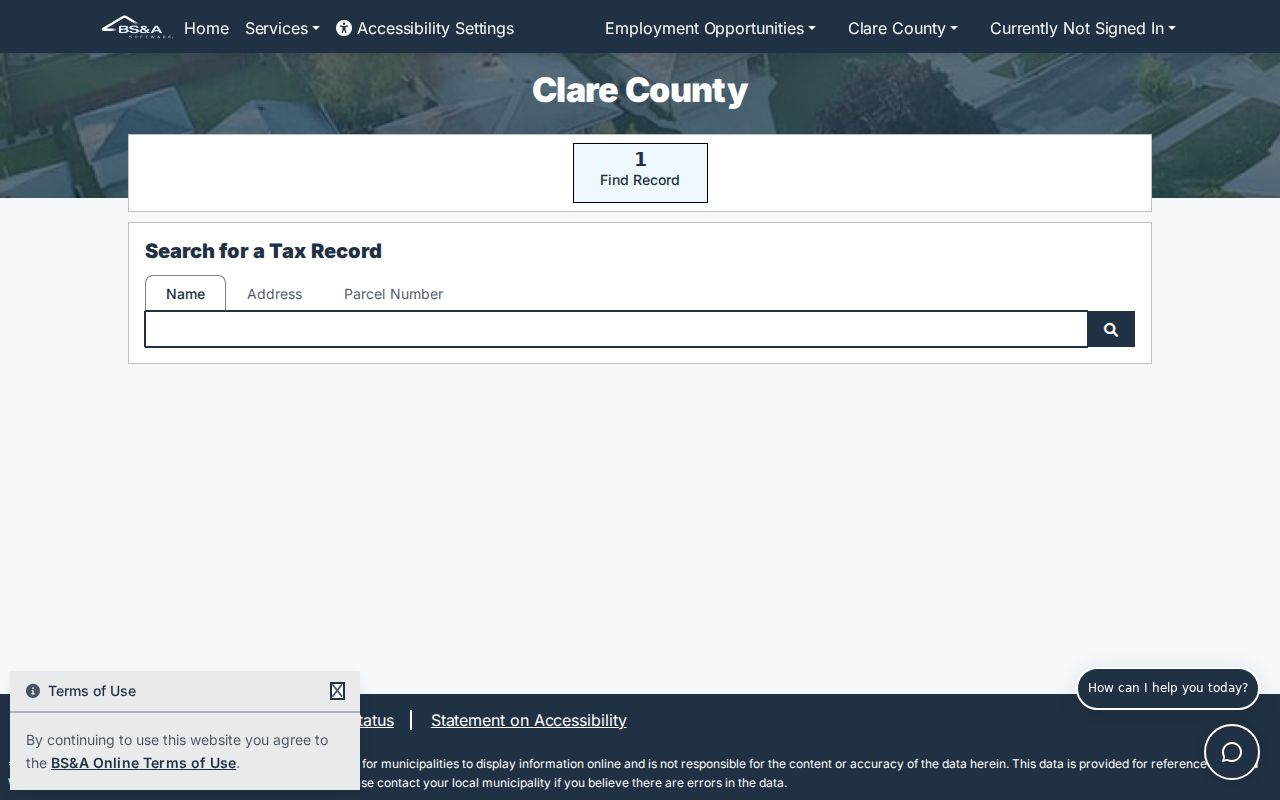
The official BS&A search page confirms the current-tax route for Clare County parcels. No live result shows without a search, so read any returned year and local unit before relying on an amount.
Look Up Clare County Tax Bills
A sound Clare County property tax search starts on the county-linked portal. From there, separate the current local-unit bill from any county delinquency. Keep a dated copy of each result. Tax status and auction details shift over time. The steps below stay inside the tax record. They never treat a payment screen as title evidence.
- Open BS&A through the Clare County Treasurer page and search the street address or full parcel number.
- Verify the local assessing unit, owner/taxpayer lines, tax year, assessed value, taxable value, and PRE status.
- Read Tax Information for the current bill and original billed-value history. Payment may still belong to the township, village, or city.
- Open Delinquent Tax Information. A pink box identifies the county delinquency for the year before the current billed year.
- Call the Treasurer when the online range is incomplete or a foreclosure, hardship, auction, or surplus-proceeds issue appears.
- Assessed value
- The assessor's value before the taxable-value cap is applied.
- Millage or levy
- A tax rate applied to taxable value for the listed taxing authorities.
- PRE
- The Principal Residence Exemption, which concerns a qualifying owner's principal home and school operating tax.
- Tax lien
- A legal claim tied to unpaid property tax, not a separate estimate of market price.
Clare County Equalization Boundaries
Clare County Equalization runs sales and appraisal studies. Each study covers a property class in every township and city. Under MCL 211.34, the office compares class levels against the 50 percent true-cash-value standard. It may also apply an equalization factor. The office assists local assessors too. That help covers property descriptions, discovery, valuation, millage rates, tax bills, and change notices. Equalization never sets an individual parcel assessment. That job stays with the local assessor. Questions about a specific value or notice should begin locally. Ask the unit named on the roll. The county office still explains class studies and subdivision record units. It also shows how it brings local rolls into balance.
Clare Tax Exemptions and Forms
PRE status appears in the property data and can change the tax treatment. Clare County form pages point to PRE claims and rescissions. Municipal pages carry poverty exemption material, disabled-veteran exemption material, and the property-transfer affidavit. The right form depends on the parcel's local assessing unit and the owner's own facts. A recorded transfer and a transfer affidavit serve different systems. The deed belongs in the Register of Deeds record. The affidavit and exemption forms feed assessment administration instead. Keep the filing receipts. Then read the next roll or notice to confirm the local assessor processed a claim. The county publishes no single form deadline covering every appeal and exemption. So follow the current notice and your local unit's instructions.
Current and Delinquent Clare Taxes
The Clare Treasurer keeps the current tax tab separate from delinquent tax records. Current amounts may still be payable to the township, village, or city. Once delinquent, the county process takes over. Online card payments routed through AllPaid carry a 2.95 percent service fee, so compare the payment total with the record before you submit it. The official Treasurer page is the starting point for delinquency, hardship, foreclosure, surplus proceeds, and public land auctions. It explains that unpaid real-property taxes can lead to foreclosure and loss after three years while interest and fees accrue. A tax-sale listing still does not prove a bidder holds current title.
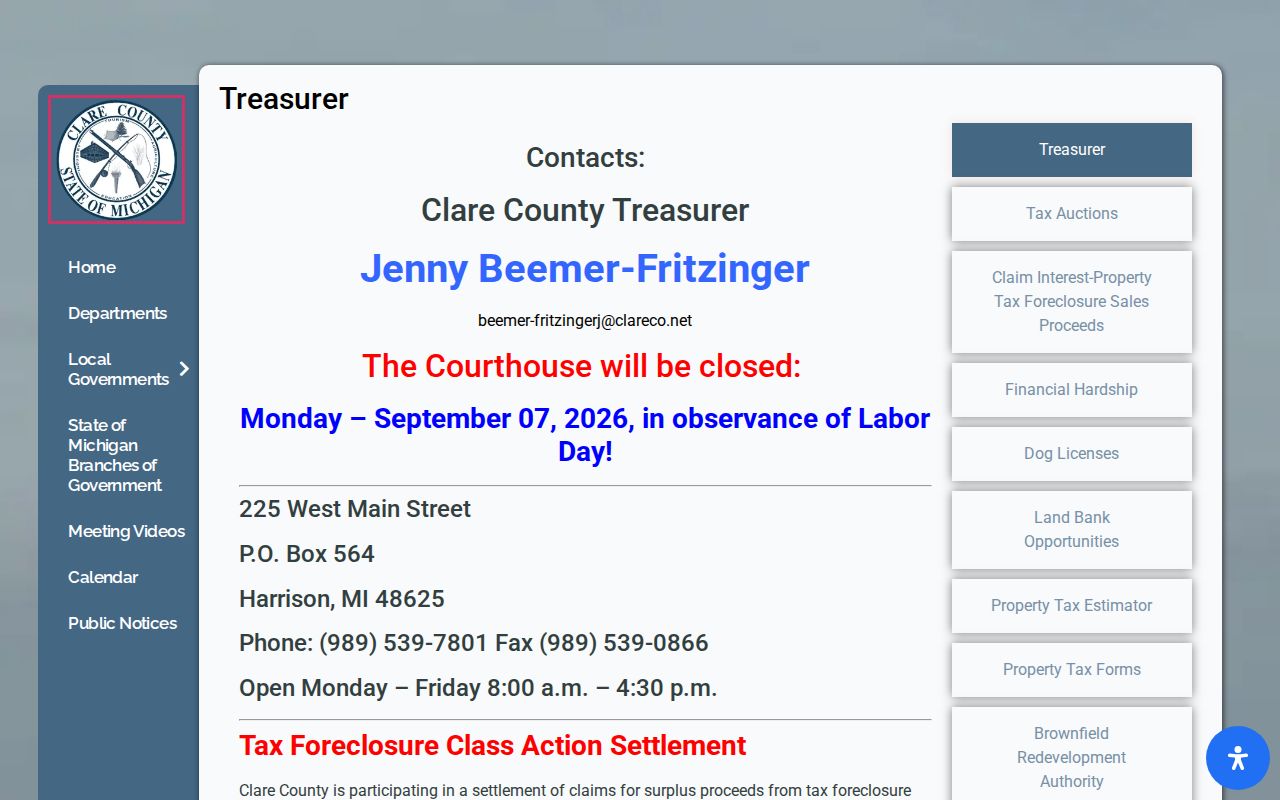
The Treasurer page shows where to begin. The live county site remains the source for current notices, forms, and changing dates.
Clare Tax-Sale Records Change
The Treasurer page posts the 2026 auction route, hardship material, and surplus-proceeds dates. Treat those notices as timely, not permanent. Recheck the county page before acting. Michigan's MCL 211.78t process uses Form 5743 after foreclosure. It can also require a later court motion on Form CC540. A title or equity holder must follow the current instructions and deadlines.
Changing dates. Auction, hardship, and surplus-proceeds dates must be verified on the current Clare County Treasurer notice before any filing or payment.
Want to check offline? Call Treasurer Jenny Beemer-Fritzinger's office at (989) 539-7801, or stop at the counter at 225 W Main Street in Harrison. Bring the parcel number, the tax year, the local unit, the owner or taxpayer name, and any notice number so the staff can pull the right record.
Contest a Clare County Assessment
Challenge an assessment at the source. That means the local assessor named on the roll or the assessment-change notice. It is not Equalization and not the Register of Deeds. Before you argue anything, compare the parcel number, property class, land and building details, sale history, PRE status, and legal description against what you know to be true. Gather your evidence: a dated BS&A printout, photos of any factual errors, comparable sales, and any survey or recorded document that supports the claimed mistake.
Clare County publishes no single appeal calendar covering every local unit. So read the date and meeting instructions on your current notice. Ask the local assessor about the Board of Review route. Miss that stated window and your next step may be closed off. Tax and assessment appeals run on procedure. So get qualified Michigan advice whenever a deadline or a jurisdiction is in dispute.
Appeal window. Clare County does not publish one universal local-unit deadline; use the current assessment notice and contact the named assessor at once.
Clare County Tax Record Fallbacks
Online property records can leave gaps. Older tax years may be missing. A status change may show no explanation. The Treasurer counter is open weekdays. It takes questions on current and delinquent tax matters, while Equalization can walk you through county studies and local-unit contacts. Some county records are not indexed anywhere. A written request under the Michigan Freedom of Information Act is the fallback.
Clare County's FOIA form lets you request copies, certified copies, inspection, or subscriptions. Delivery can be by pickup, onsite copying, mail, email, or county-supplied digital media. Spell out the parcel number, situs address, tax year, record type, and the likely custodian. Send the completed form to FOIA@clareco.net. You can also fax it to (989) 539-2588 or mail it to the county coordinator at 225 W Main Street, PO Box 438, Harrison, Michigan 48625. Michigan FOIA generally requires a response within five business days. The county may take a written extension of up to ten business days.
Note: A Clare County property tax record covers assessment and payment data, while the newest recorded deed remains the ownership record to verify.