
Compare Clare County Property Value Numbers
Michigan assessment records label each figure by purpose. Assessed value is the assessor's number before equalization. State equalized value reflects that adjustment, and taxable value is the capped basis driving the tax bill, while a past sale price simply records a transaction. Two similar Clare County numbers are rarely interchangeable, so check the year and the label on every value first.
| Value type | What the number means | Record location |
|---|---|---|
| Assessed value | Local mass-assessment figure used before equalization | Local assessment roll and BS&A |
| State equalized value | Equalized figure generally set at 50% of true cash value | Assessment roll |
| Taxable value | Capped tax base that may uncap after a transfer | Assessment and tax tabs |
| Last sale price | Consideration reported for an earlier transfer | BS&A sale history and recorded deed context |
Under MCL 211.27a and 211.34, SEV generally sits at 50% of true cash value. That is a statewide assessment level. It is not today's market price. One sale is not the assessor's final word. Taxable value stays capped below SEV until a qualifying transfer uncaps it in the following tax year, which is why the two Clare County figures can diverge.
Read the Clare County Assessor Value Fields
The county's assessment entry point is Clare County BS&A Online. A parcel card there shows the owner of record. It also lists the situs address, property class, and legal description. Values, sales, and building details share one card. Exemptions and tax tabs fill out the rest. Clare indexed years and any per-hit charge can vary. Date each result rather than assuming full historical coverage.
| Parcel-card field | How it helps interpret value |
|---|---|
| Assessment year | Fixes the date of the valuation snapshot |
| Assessed value and taxable value | Separates valuation from the capped tax base |
| Property class | Places the parcel within the assessor's classification |
| Sale history | Adds transaction dates and prices for context |
| Building and land details | Explains characteristics used in mass-assessment review |
Save the parcel PIN and local unit. Clare County Equalization handles county studies and factors, while each assessment roll stays with the local assessing unit that produced it.
Locate a Clare County Property Value by Address
Begin with the situs address you already know. Then verify the parcel PIN and local unit before reading any value. This step matters most near the City of Clare boundary, where the city straddles both Clare and Isabella counties. A postal place name alone will not do.
- Search the address in Clare County BS&A Online and confirm the parcel PIN.
- Record assessed value, SEV, taxable value, property class, and assessment year exactly as labeled.
- Open sale history and note the transaction date, price, grantor, and grantee when shown.
- Use the deed reference to verify that the sale applies to the same legal description.
- Use GIS and building fields as context, never as an appraisal or survey.
- Assessed value
- The local mass-assessment figure before equalization, not the taxable value.
- True cash value
- Michigan's statutory value concept to which the 50% assessment level relates.
- Assessment ratio
- The relationship between assessed or equalized value and true cash value.
- Sale consideration
- The amount associated with a recorded transfer, subject to the instrument's facts.
- Reassessment
- A later valuation snapshot that can change as facts, studies, or law apply.
Put Clare County Sale Price in Context
The Clare County property-sale search lets you filter by date, price, grantor, grantee, property class, and residential status.
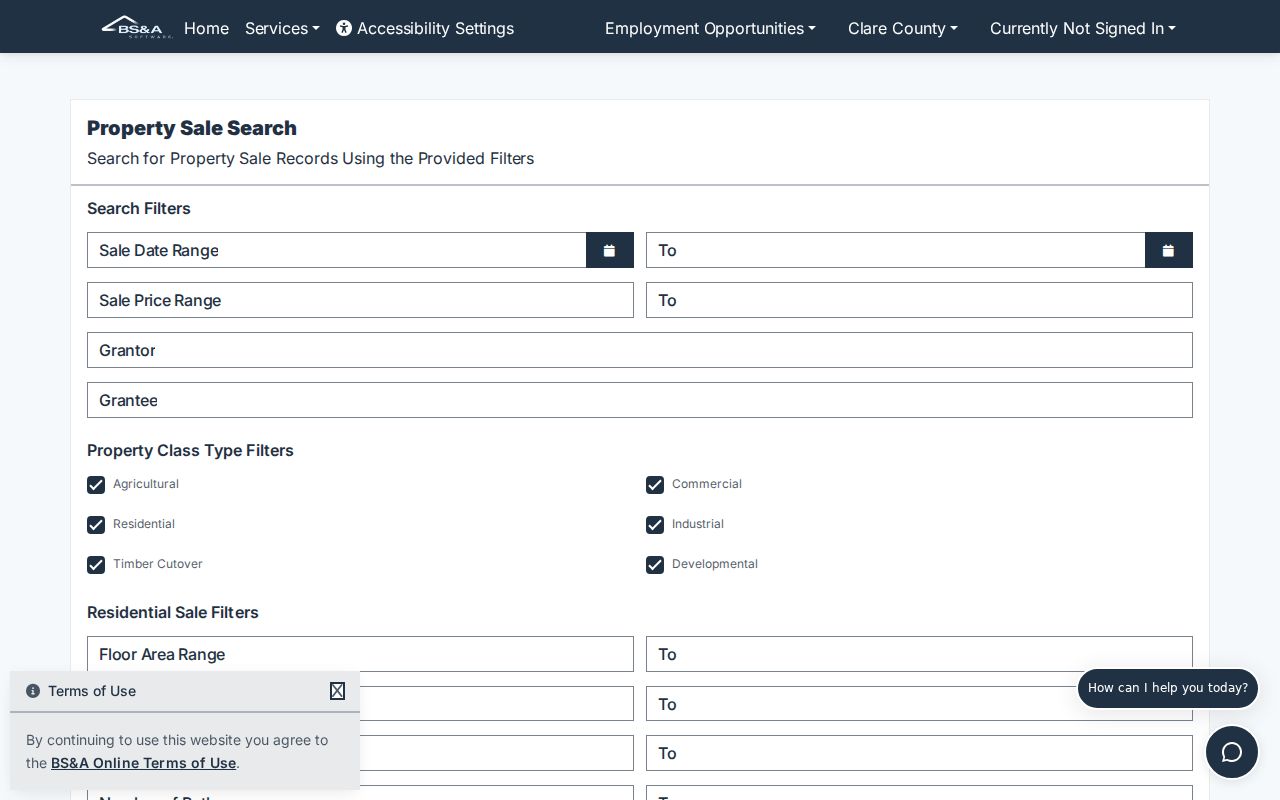
Comparable sales start there. Each result still needs a closer look. A transfer can reflect family terms, an estate, a land contract, or multiple parcels, any of which makes the printed amount a poor stand-in for current market value. Confirm the parcel and deed before comparing sales. The Register of Deeds record supplies the legal description and transfer context, and BS&A links each sale line back to assessment data.
Why Clare County SEV and Taxable Value Diverge
Michigan caps taxable-value growth until a transfer triggers statutory uncapping in the following tax year. That gap widens over time. Two similar parcels can carry very different taxable values. The gap alone proves neither parcel is misassessed. A Principal Residence Exemption, poverty exemption, or veteran relief changes the tax picture, not the physical worth of the land. Keep exemption questions apart from sale-value estimates. Exemption answers are not sale answers. For bills, delinquency, exemption routes, and appeals, the Clare County property tax records page goes deeper. Note: A transfer affidavit and PRE shape assessment administration, but neither is a private appraisal of likely proceeds.
Clare County Equalization Is Not a Parcel Appraisal
Clare County Equalization runs annual studies. It builds class valuation and equalization factors, supports local assessors, and publishes subdivision resources. None of that replaces the local assessor's individual roll. A factor lines classes and units up with the state assessment level. It is not an opinion about one home.
For a parcel field or local-unit question, call Equalization at (989) 539-7894 or the local assessor. Keep the year, class, local unit, and source handy. Comparisons across Clare County fall apart without them.
Michigan's equalization process also shows why a class-wide factor and a parcel concern are different disputes. The county studies levels across classes and units. The local assessor applies the roll to one parcel. Before concluding anything, ask which figure changed, which year, and whether the source is assessed value, SEV, or taxable value.
If the aim is a current sale range, county records form the factual base rather than the finished answer. Narrow to valid nearby sales, same class, same period. Review the recorded transfer context too. Then weigh what the public card leaves out, and let a licensed appraisal add the inspection and market analysis a mass-assessment roll cannot provide.
Add Clare County Parcel Facts Without Inventing Value
FetchGIS can add acreage, parcel shape, imagery, measurements, and nearby land context. BS&A building fields show recorded structure characteristics. Together they can explain why two assessed values differ. They cannot see inside a building. Unrecorded improvements and legal boundaries stay off the card, and environmental facts usually do too. The county treats its GIS maps as reference material, not surveys, and the assessor's value is a mass-appraisal record rather than a purchase recommendation. Use both to frame sharp questions for the official custodian or a licensed professional.
Date Every Clare County Property Value Claim
Clare County publishes no single countywide value-change rate. City ratio examples can mislead you. So can one-off sales and auction notices. None of these make a market trend. Start with the current assessment year and the official roll for the parcel. Then compare valid transactions from a defined period within the same property class.
The Treasurer's page shifts with each foreclosure and auction cycle. Those listings belong to delinquent-tax processes and say nothing about ordinary market value. Do not rely on any figure unchecked. Recheck the assessor, Equalization, the Treasurer, and recorded deed records for the parcel.
Know What Clare County Assessed Value Cannot Prove
A Clare County assessed value cannot prove what a willing buyer would pay today. Nor can it settle title, boundaries, building condition, zoning approval, financing value, or the legal force of an exemption. Even a recent sale price may fall short. It might not be an arm's-length deal or reflect current conditions.
Value is not price. Clare County assessed value supports taxation. It is not what a property will sell for and is not a licensed appraisal.
For a purchase or sale, pair official property records with fresh inspections, market evidence, and qualified appraisal or legal help. Cite the source and date. Never report one unexplained number as "the value."