
Identify a Clare County Owner
Chasing a Clare County owner means working the record trail, not trusting one lookup. Clare County BS&A Online ties an address to its assessment parcel. It also shows the owner and taxpayer fields. Grab the full PIN there. It links the account to FetchGIS and pins down the correct legal description. The newest deed closes the loop with recorded confirmation.
- Search the situs address in BS&A and open the matching parcel, checking its local unit and legal description.
- Record the owner-of-record line, taxpayer line, mailing address, PIN, and newest sale or deed reference shown.
- Use the PIN in FetchGIS to make sure the record points to the intended physical parcel.
- Search the newest grantee through the Clare Register of Deeds and compare recording date and legal description.
- If the grantee is an LLC, check Michigan's current business registry without claiming a beneficial owner.
This workflow answers the ownership question from the public record itself. For a closer look at the roll display and the deed recency check, see the Clare County current owner record.
Read Clare Owner Fields
A BS&A parcel card packs plenty into one page. The header typically lists the property address and Parcel Number. Below it sit Owner/Taxpayer Information, assessed and taxable values, land facts, the legal description, sale history, and building details. Treat the owner column as the roll's owner-of-record display. The taxpayer or mailing line can differ, so keep both.
The official Clare landing page shows the address, name, and parcel search routes on its face.
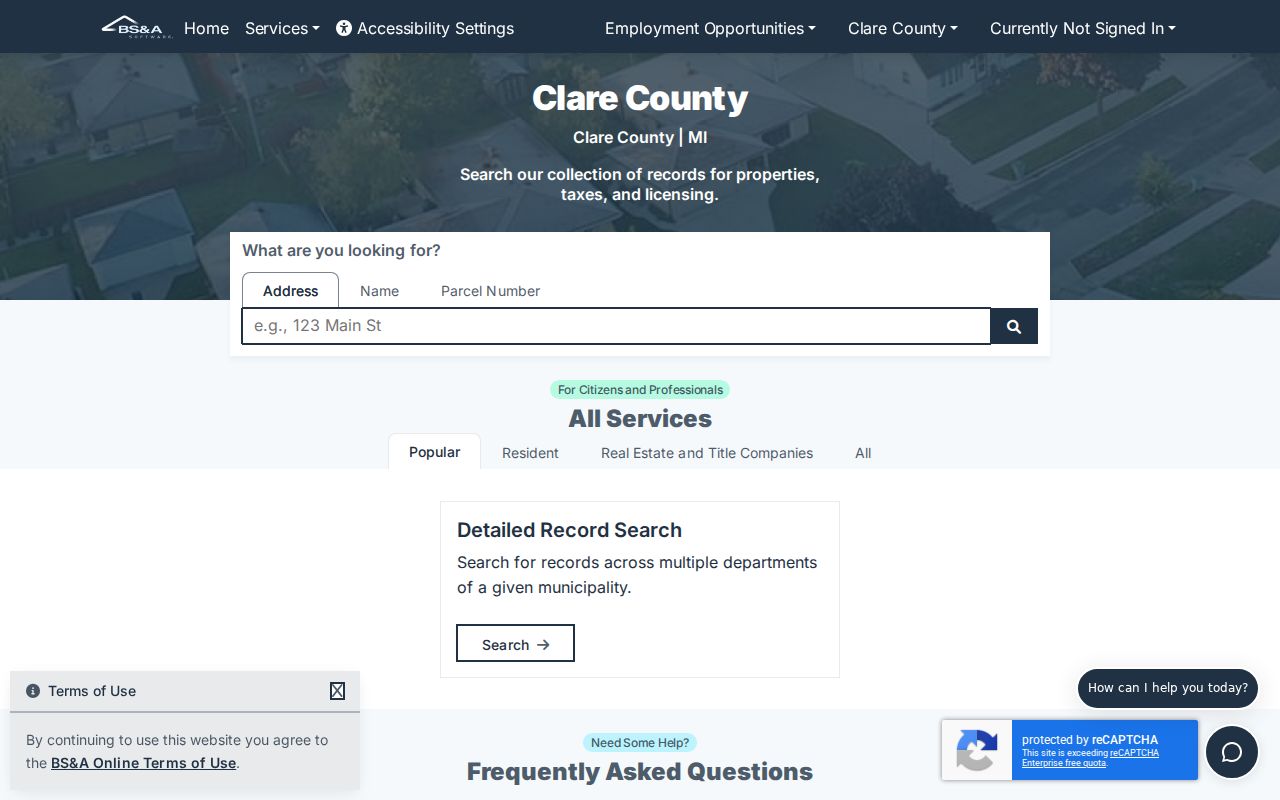
That entry point only gets you started. A dated parcel result is what actually answers who owns a specific property.
Clare Property Ownership Sources
No Clare County source handles every job alone. The roll gives a quick starting name. FetchGIS confirms the physical parcel. The recorder index settles which document was recorded most recently. A business filing shows an entity's public registration, not the natural people who benefit from the land.
| Where ownership appears | What it gives | How current |
|---|---|---|
| BS&A assessment roll | Owner/taxpayer, mailing and situs fields | Current roll; refresh interval unpublished |
| Register of Deeds | Latest grantee, recording reference, legal description | Most recently recorded instrument |
| FetchGIS | Parcel shape, PIN, address, nearby context | Reference map; update cycle unpublished |
| MiBusiness Registry | Entity status, filings, and agent details | Current state filing system |
Clare does not publish a roll-refresh interval, so save the date of your search. After a recent sale, the newest deed may name a new grantee well before the assessor display catches up.
Confirm Clare Ownership by Deed
To confirm ownership in Clare County, work from the deed itself. The Clare County Register of Deeds keeps the public vault at 225 W Main Street in Harrison. The office also links Tapestry and Laredo for online deed records. Start with the apparent owner of record as grantee. Then set the newest deed beside the parcel. Compare the recording date, reference, and legal description. A name match alone proves nothing if the land described does not line up.
Online access may sit behind an account or a fee. Clare's earliest online year is not published. Vault searching runs weekdays, with public searching closing at 4:00 p.m. Call (989) 539-7131 about the imaging cutoff, older books, and the best request route.
Clare LLC and Trust Owners
A roll or deed may vest ownership in an LLC, trust, estate, or fiduciary. Keep that exact indexed wording. Michigan's MiBusiness Registry Portal, launched in 2025, is the current state route for entity searches, filings, certificates, and copies. One caution applies. A registered agent is an entity contact, not automatically the property owner or beneficial owner.
Trusts and estates take different digging. Search the exact trust or estate name, the trustee, the personal representative, and related grantor and grantee forms. If a deed cites probate authority, use MiCOURT as a lead, then ask the local probate clerk for the parcel-related order. Wills and protected probate material may never appear online.
Clare Addresses Can Mislead
One Clare County ownership search can turn up three addresses at once. The situs is where the parcel sits. The mailing address is where tax notices go. The legal description identifies the conveyed land itself. A rural parcel may defeat a full postal address. A partial street, an intersection, the PIN, or the legal description may beat it.
The postal label can mislead you too. The City of Clare spans both Clare and Isabella counties. A Clare address does not prove the parcel belongs in this county's roll. Harrison mail can reach land outside city limits. Farwell labels blur village and township lines. Confirm the county, local unit, PIN, and map shape before you trust a result.
Clare Property Fraud Alerts
Enroll the owner name next. You can do this through the Property Fraud Alert link from the Clare Register of Deeds. The service may send notice when a document is recorded under that indexed name. It does not stop recording, prove fraud, or fix a faulty instrument.
When an alert arrives, verify the document number through the official ROD contact. Compare the parties and the legal description. Seek qualified Michigan advice if a correction is needed. Never pay an unsolicited deed-copy or fraud-protection demand without checking with the county first.
Limits of a Clare Owner Lookup
A property owner search surfaces public record names, nothing more. It cannot show who lives at an address. It cannot expose private trust beneficiaries. It cannot settle competing title claims or prove an unrecorded interest. Assessment values are not appraisals. GIS lines are not surveys. Protected identifiers should never appear in a public parcel card anyway.
- Owner of record
- The party named by the current public roll or recorded instrument.
- Grantee
- The party receiving an interest in a recorded deed.
- Title
- The legal rights in land, which can require more than an owner-name result to establish.
- Situs address
- The physical property location, distinct from the tax mailing address.
Lawful use. Clare County owner records support property diligence and civic research; they do not permit stalking, harassment, threats, or evasion of protected addresses.
Michigan runs an Address Confidentiality Program for qualifying survivors. It provides a substitute address and mail forwarding. Do not try to match a participant to a parcel through other public files, and contact an owner only for a lawful property purpose.
Offline Clare Owner Checks
If BS&A keeps missing an address, widen the search. Use the complete PIN, a partial street, or the owner name. The local-unit clue also helps. FetchGIS accepts intersections and coordinates too. When the parcel still will not match, call Equalization at (989) 539-7894 and ask which local assessor keeps that roll. Have the postal city ready, along with the suspected township or city.
The Register of Deeds vault handles recorded confirmation. It is open on weekdays, and searching stops at 4:00 p.m. Bring every grantor and grantee variant you know, including initials, spouses, trust wording, LLC punctuation, and estate forms. If the web index runs dry, ask about deed books, microfilm, and imaging. Clare publishes no verified online cutoff year. A written Michigan FOIA request suits a non-indexed county record, though it never replaces a normal parcel or deed search. Clare's form takes a detailed description, a delivery choice, and a request for a copy, certified copy, inspection, or subscription. List the address, PIN, legal description, date range, document type, and likely custodian.
Early ownership research in Clare County needs one caution. The Farwell courthouse burned in 1877 and destroyed records. The county seat later moved to the Harrison area. A missing early result may just mean lost material or a changed place name, not that no sale ever happened. Search Farwell, Harrison, Budd Lake, township, subdivision, and legal-description terms fitting the period. Ask the vault which deed books or reconstructed indexes survive. Libraries, newspapers, and archives can back an identity or address clue, but the newest recorded land instrument remains the confirmation step.
Death and probate can cloud the current owner of record. An estate name may sit on the roll until a later instrument and roll update arrive. Look for a fiduciary deed, survivorship instrument, affidavit, trustee wording, or probate-related recording. Death records, obituaries, and court petitions support identity work. None replaces the deed or order that affects the parcel. Capture only the public parcel-related document and skip unrelated family details.